What does Alphabet do?
Alphabet Inc was created in 2015 after Google reorganized its businesses to make its activities "cleaner and more accountable".
Google itself became a subsidiary of Alphabet, with the division looking after products such as Search, Maps, YouTube, Chrome, and the Android mobile phone platform.
Some other businesses which were previously owned by Google were moved to become subsidiaries of Alphabet.
Waymo
Waymo started in 2009 as a Google project to build a self-driving car. It is now run as a separate company under Alphabet.
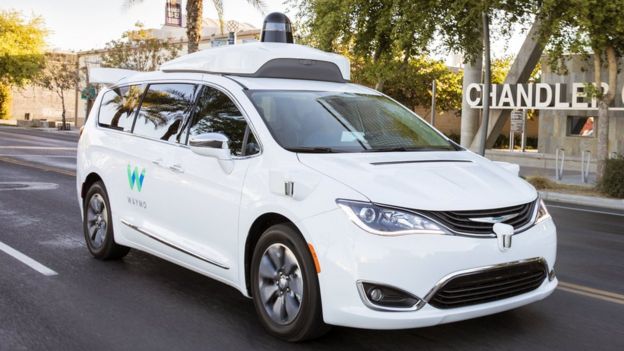
Waymo's cars feature sensors to detect pedestrians
It launched its first commercial service in December 2018, offering autonomous robot-taxi rides to people in Phoenix, Arizona.
The company says it has more than 1,000 riders using the service, and its autonomous cars have driven more than 10 million miles on public roads.
Calico
Google launched its health-focused research and development company in 2013, with Larry Page announcing in a blog post that its work would be based around the research areas of "health and well-being, in particular, the challenge of aging and associated diseases".
"We are scientists from the fields of medicine, drug development, molecular biology, and genetics," says the firm on its website.
"We're tackling aging, one of life's greatest mysteries."
Google launched its health-focused research and development company in 2013, with Larry Page announcing in a blog post that its work would be based around the research areas of "health and well-being, in particular, the challenge of aging and associated diseases".
"We are scientists from the fields of medicine, drug development, molecular biology, and genetics," says the firm on its website.
"We're tackling aging, one of life's greatest mysteries."
Sidewalk Labs
Sidewalk Labs is focused on smart cities and explores how data-gathering sensors can be used to manage crowds and traffic.
In October, it was given the green light to create a "smart city" in a disused area of Toronto, Canada. But the development will be much smaller than it had wanted.

Google wants to create a high-tech neighborhood with eco-friendly buildings, robots, and sensors collecting a range of data
Sidewalk Labs had wanted to develop a 190-acre (0.7-sq-km) site but was given permission for just 12 acres.
And any data the company collects from its sensors must be treated as a public asset.
Sidewalk Labs is focused on smart cities and explores how data-gathering sensors can be used to manage crowds and traffic.
In October, it was given the green light to create a "smart city" in a disused area of Toronto, Canada. But the development will be much smaller than it had wanted.
Google wants to create a high-tech neighborhood with eco-friendly buildings, robots, and sensors collecting a range of data
Sidewalk Labs had wanted to develop a 190-acre (0.7-sq-km) site but was given permission for just 12 acres.
And any data the company collects from its sensors must be treated as a public asset.
DeepMind
Acquired by Google in 2014, DeepMind is a UK-based company researching artificial intelligence and machine learning.
Its AlphaGo software has beaten world champions at the ancient game of Go.
It led one Go master to retire from the game because he felt the AI could not be beaten.
And in October, it said its AlphaStar program had reached the top league of one of the most popular sports video games, Starcraft 2.
It hopes AlphaStar and other projects will help it develop other AI tools that should ultimately benefit humanity.
Acquired by Google in 2014, DeepMind is a UK-based company researching artificial intelligence and machine learning.
Its AlphaGo software has beaten world champions at the ancient game of Go.
It led one Go master to retire from the game because he felt the AI could not be beaten.
And in October, it said its AlphaStar program had reached the top league of one of the most popular sports video games, Starcraft 2.
It hopes AlphaStar and other projects will help it develop other AI tools that should ultimately benefit humanity.
Wing

The wing is Alphabet's drone delivery service.
It launched its first commercial service in April, delivering takeaway food, coffee, and medicines by drone to about 100 homes in Canberra, Australia.
It has been testing its drones in Australia since 2014, but many residents have complained about the noise.
Wing said the feedback obtained during its trials had been "valuable" and it hoped to "continue the dialogue".
Loon
Created by Google's research lab X in 2011, Loon became a subsidiary of Alphabet in 2018.
It aims to bring internet access to areas with poor connectivity, by floating solar-powered hotspots over regions where building phone masts would be too expensive.
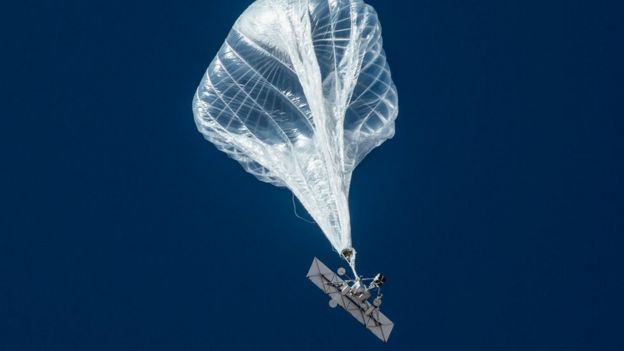
A solar-powered transmitter hanging from a balloon
The company has previously let mobile operators in Peru and Puerto Rico use its balloons free of charge when phone masts have been damaged by natural disasters.
Each of the giant helium balloons is the size of a tennis court, but they have a lifespan of just five months, as the plastic degrades.
Some aviation authorities have also expressed safety concerns about the balloons.

No comments:
Post a Comment